


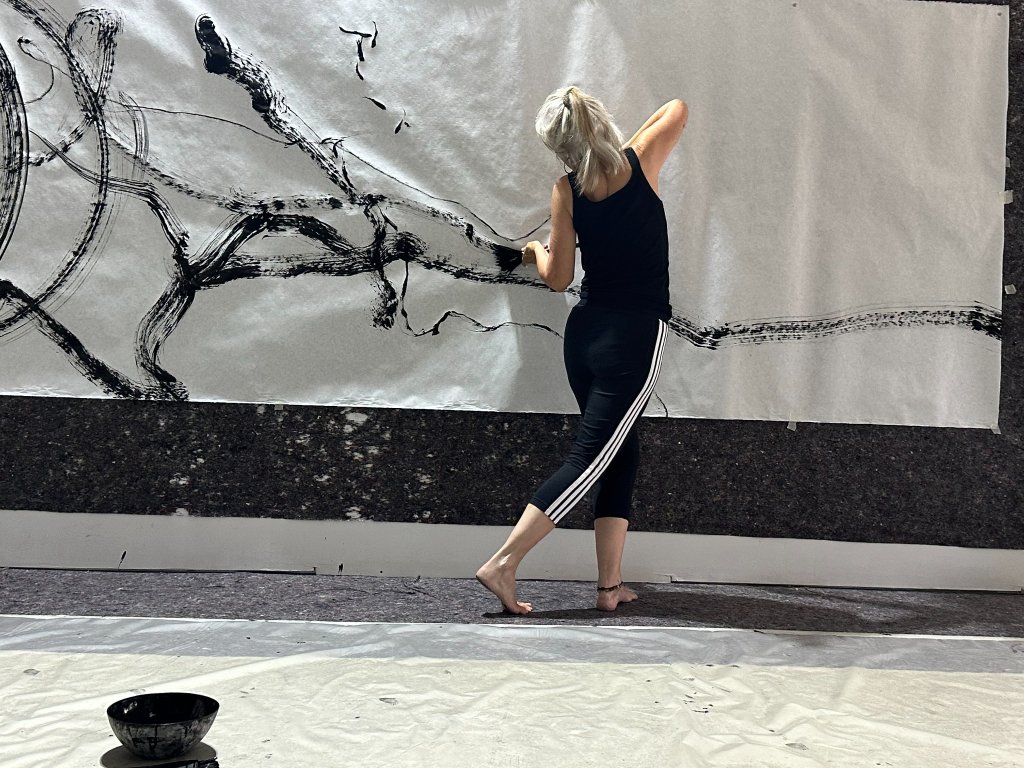
Drawing on decades of Japanese calligraphy, dance, and improvisation, Barcelona-based artist Eva Ibáñez Cano explores the gestures that come before a mark appears on paper, and what remains after the brush moves on.
A single stroke of ink can reveal a surprising amount. The speed of a hand, a moment of hesitation, a sudden change in pressure. Once it’s there, it stays.
Eva Ibáñez Cano has spent years exploring this relationship between physical action and its visible result. Her background in Japanese calligraphy, contemporary dance, and improvisation has led her to develop Practices of Presence and Trace, an artistic research methodology that looks at how we create, respond, and make decisions as a work takes shape.
She shares this research through workshops where participants observe their own habits, experiment with unfamiliar approaches, and discover what happens when they let go of a fixed outcome. No artistic experience is necessary.
I asked Eva about her practice, the influence of her teachers, and the value of knowing when to stop.
Your work considers everything that happens around the moment of making a mark. How do you approach that moment?
In my practice, movement begins before the brush touches the paper and continues after it leaves. The paper records a moment within this infinite movement.
Before contact, I cultivate the conditions from which a gesture can emerge without its form being predetermined. I call this an “operational void”: a space of availability rather than absence, where the need to anticipate and control can recede.
After the brush leaves the surface, movement continues through space. The paper preserves its visible trace: the material record of an irreversible action in which body, perception, time and materials have come into relation.
What role does attention play in your drawing?
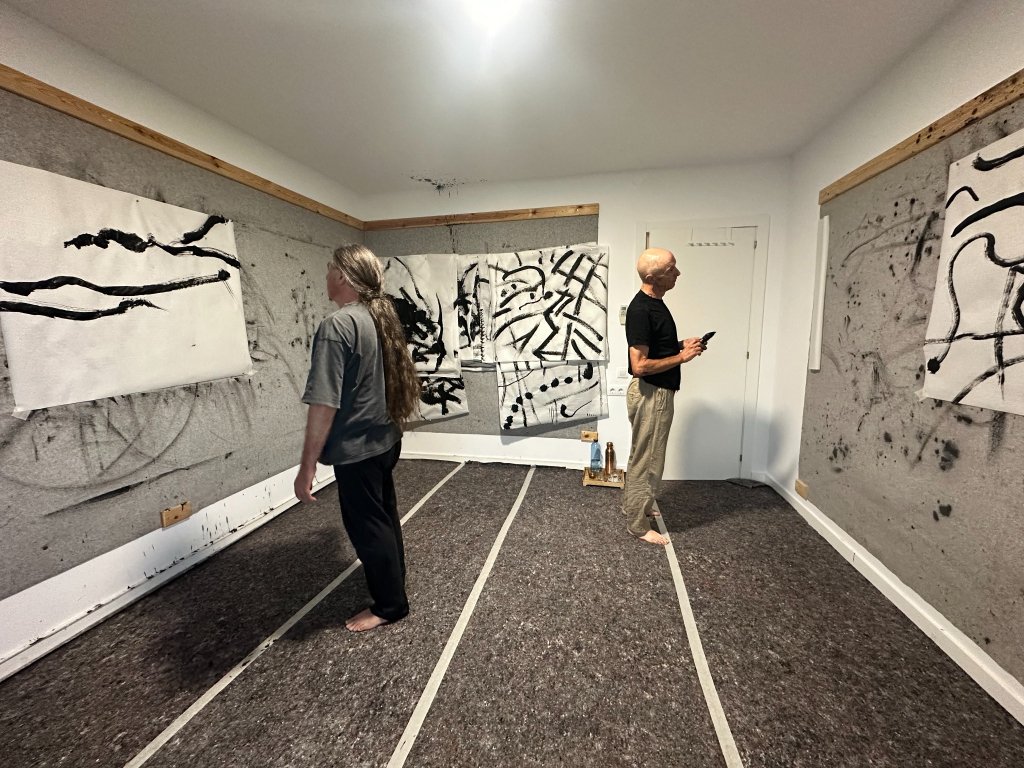
Attention shapes how I relate to my body, the paper and the surrounding space. The practices explore three qualities of attention: an inward focus (IN), an open, receptive gaze (OUT), and the possibility of sustaining both simultaneously (IN–OUT). This last quality relates to MA (間), the Japanese concept of the interval or “between”, which I investigate as an active space of relation.
Movement has its own musicality. Each person organises it through tempo, accents, intensities, pauses, silences, continuities and interruptions. These qualities shape the phrasing of the gesture and leave their trace on the paper.
The materials also participate. The paper responds to changes in pressure, speed, ink load and brush movement. Working with sumi ink on absorbent paper makes irreversibility central to the practice: I do not correct what has appeared to bring it closer to a predetermined image. The mark preserves the moment of its making.
How have your experiences with Japanese calligraphy, dance, and improvisation come together in your own work?
They developed through a long period of practice rather than a single moment.
I began studying Shodō, Japanese calligraphy, with Keizo Abiko Sensei in Barcelona in 1995, and continued my studies with Nihon-Shūji in Kyoto. I am now a member of the Bokushin school, studying with Norio Nagayama Sensei.
In 2013, I began studying Bokushō, Japanese abstract calligraphy, with Sōshō Kimura Sensei in Minamiizu, Japan. His teaching profoundly changed my understanding of the continuity of movement. Alongside calligraphy, I explored the body through contemporary dance and improvisation.
These experiences informed The Infinite Stroke: the understanding that the paper is not the limit of the gesture. Movement precedes contact, crosses the paper and continues beyond it.
Practices of Presence and Trace grew from this research. It is an artistic research methodology that cultivates the conditions from which other ways of relating to the creative act and the emerging work can become possible. It works through the body, attention, perception, movement, gesture, ink and paper.
What do participants discover when they try these practices for themselves?
One of the first things participants can recognise is their habitual way of moving: the patterns and automatic responses that shape their gestures and strokes. Observing their own traces helps make these habits visible.
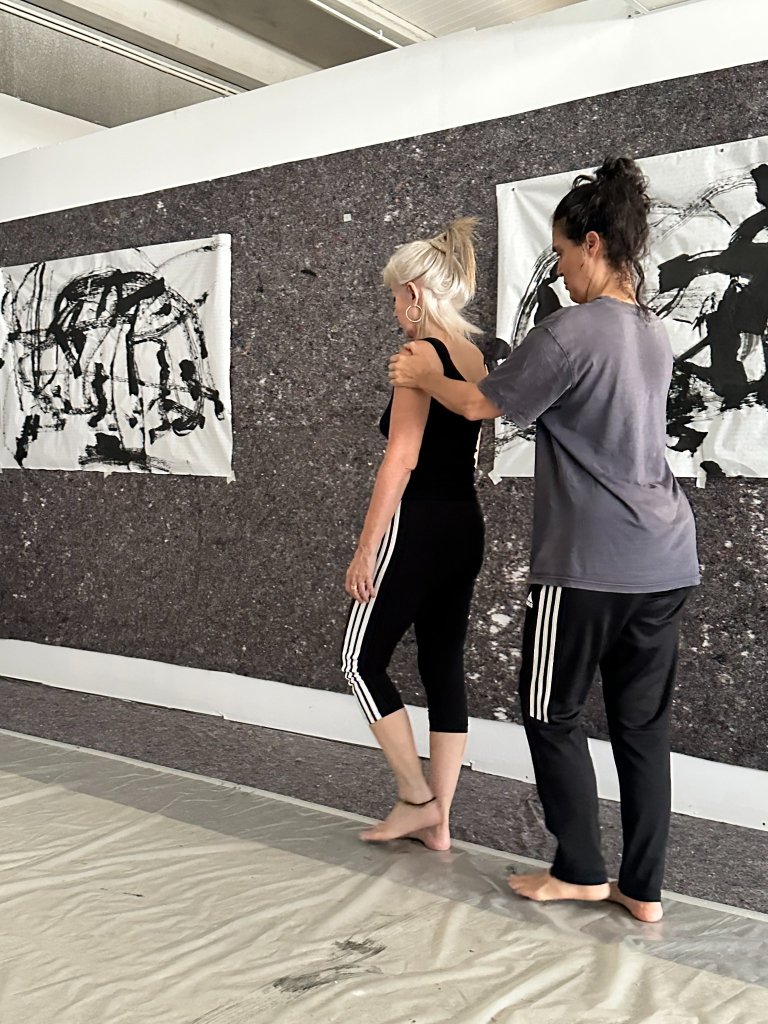
Working in pairs broadens this investigation. Through observing another person’s movement and traces, and sharing what they notice, participants can recognise aspects of their own practice that might otherwise remain unnoticed. They also encounter possibilities beyond their habitual repertoire. Through deliberate exploration and repetition, these possibilities pass through their own bodies and become available in their practice, without becoming forms to copy.
This creates a space of freedom. There is no predetermined result to achieve. Participants can connect with their inner experience, investigate what is possible and discover other ways of relating to movement, gesture and trace. The finished work is a result of this process rather than its purpose.
How are these practices shared, and what else do participants explore?
The methodology is shared through Practices of Trace, a sequence of four progressive sessions, and The Irreversible Gesture (TIG), an intensive laboratory.
The sessions are open to beginners; no previous experience in drawing or Shodō is required, and there is no need to be an artist.
The work also involves discernment: learning to distinguish the desire to continue acting from what the emerging work asks for. Participants investigate when to intervene, when to step back and when to sustain non-doing. A work can remain open if it seems incomplete but no new living impulse arises.
An optional Performance Day introduces the presence of an audience. Its gaze becomes part of the field of relation. Participants investigate how to include that presence while remaining attentive to the body, the space and the work as it emerges.
Has your relationship with drawing changed over time? And where is that taking your work now?
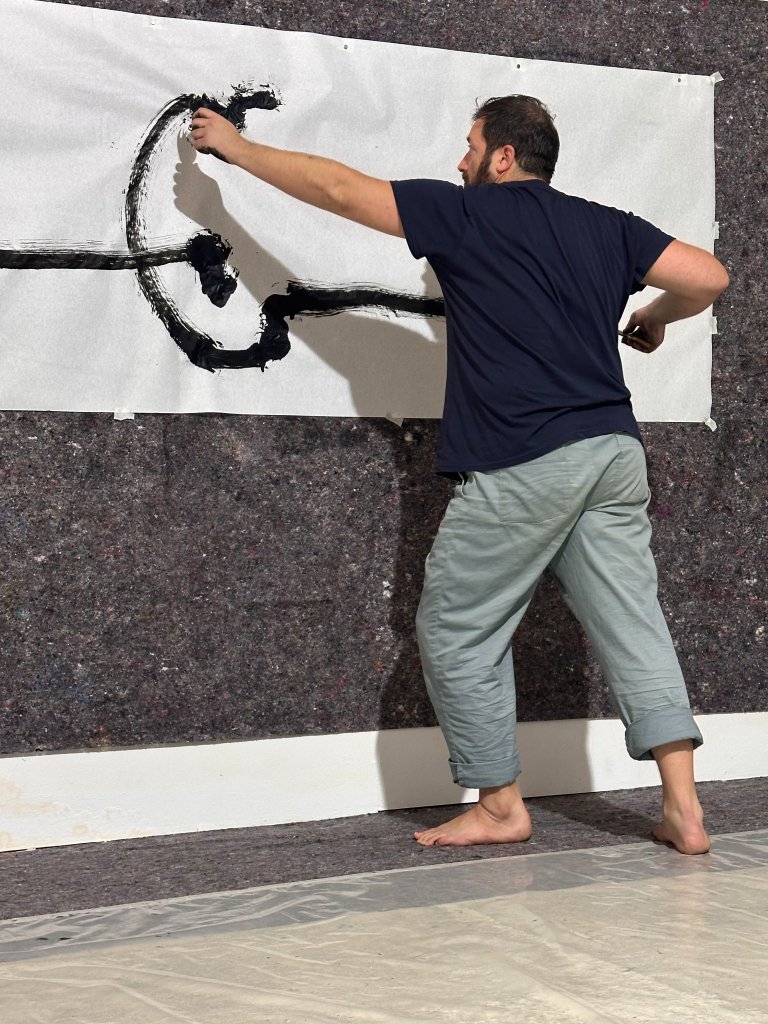
Yes. I have become more interested in the experience of drawing and the conditions from which a trace can emerge. The work on paper preserves something of that experience, while another trace remains in the body.
This has also changed my relationship with the emerging work. As something appears, I take responsibility for it: I observe, listen and discern whether to continue, pause or leave it open. My ability to keep acting does not necessarily mean that the work needs another intervention.
I am currently developing Instances of Presence, a proposal that extends this research into architectural space. It is conceived for spaces undergoing opening, transformation or first occupation. Through bodily action and an irreversible ink trace on large-format paper, it explores the moment when architecture becomes a lived experience.
Thank you, Eva, for taking the time to share your thoughts and for introducing us to a different way of approaching drawing. We’re looking forward to seeing where your research takes you next!
About Eva Ibáñez Cano
Eva Ibáñez Cano is an artist whose practice brings together Japanese calligraphy, movement, and artistic research. She has studied calligraphy in Barcelona and Japan since 1995. Her work explores attention, gesture, and the relationship between physical action and the marks it leaves behind.
Learn more about her work and workshops at evaibanezcano.
Images: The Irreversible Gesture (TIG) and Practices of Trace workshops. Photos: Eva Ibáñez Cano.
Stay close to the scene
FrikiFish is an independent project, built and run by one person, focused on documenting the creative scene around Barcelona.
If you want to keep up with new openings, artists, and opportunities, you can join the newsletter.
Even €2–€5 helps keep things going.
thank you
for being part
of this